

Centering Inside Vol. 3, No. 2: Special Edition 2026
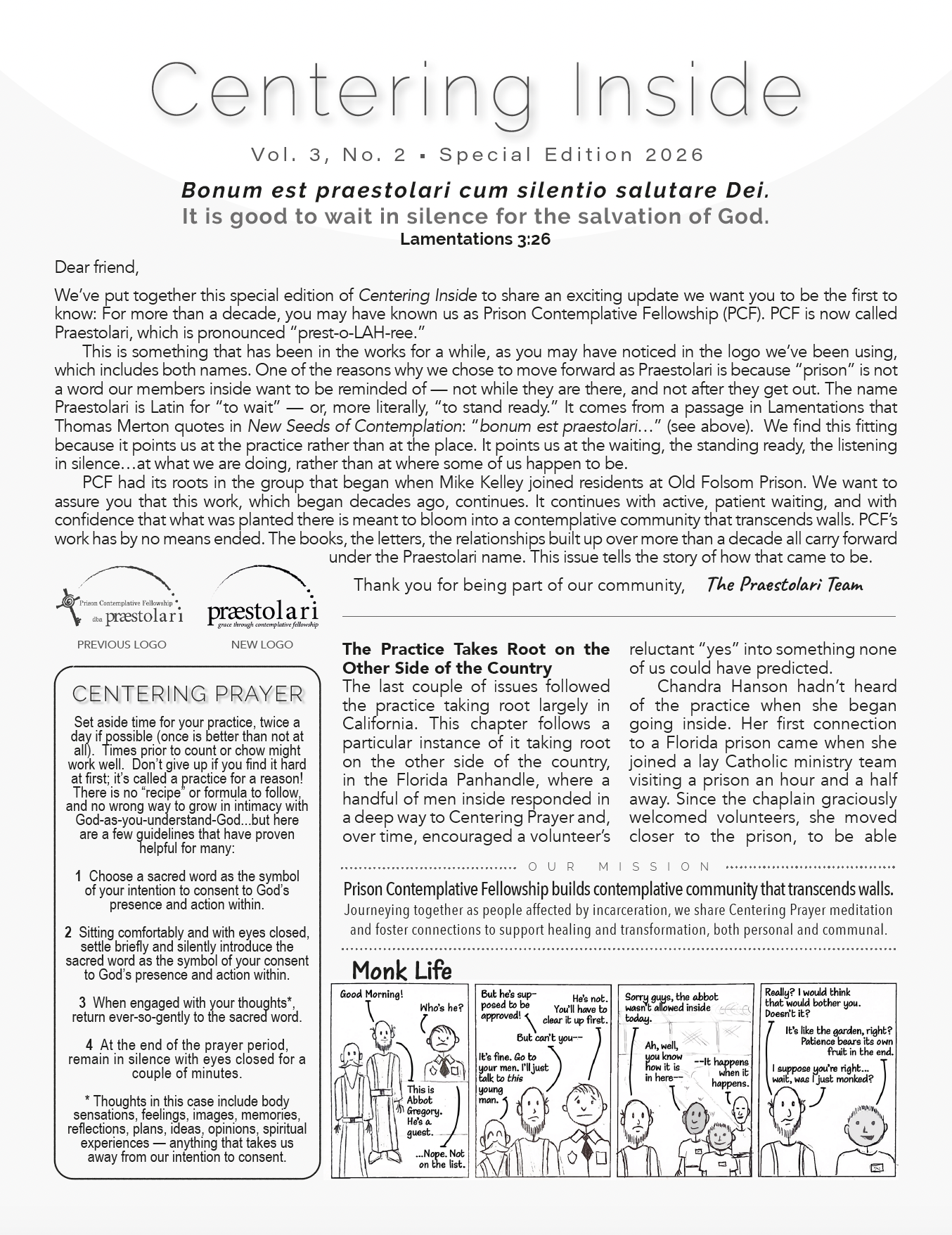
The following article originally appeared in the Special Edition 2026 issue of Centering Inside, Praestolari's newsletter for practitioners inside locked facilities.
Bonum est praestolari cum silentio salutare Dei.
It is good to wait in silence for the salvation of God.
Lamentations 3:26
Dear friend,
We’ve put together this special edition of Centering Inside to share an exciting update we want you to be the first to know: For more than a decade, you may have known us as Prison Contemplative Fellowship (PCF). PCF is now called Praestolari, which is pronounced “prest-o-LAH-ree.”
This is something that has been in the works for a while, as you may have noticed in the logo we’ve been using, which includes both names. One of the reasons why we chose to move forward as Praestolari is because “prison” is not a word our members inside want to be reminded of — not while they are there, and not after they get out. The name Praestolari is Latin for “to wait” — or, more literally, “to stand ready.” It comes from a passage in Lamentations that Thomas Merton quotes in New Seeds of Contemplation: “bonum est praestolari…” (see above). We find this fitting because it points us at the practice rather than at the place. It points us at the waiting, the standing ready, the listening in silence…at what we are doing, rather than at where some of us happen to be.
PCF had its roots in the group that began when Mike Kelley joined residents at Old Folsom Prison. We want to assure you that this work, which began decades ago, continues. It continues with active, patient waiting, and with confidence that what was planted there is meant to bloom into a contemplative community that transcends walls. PCF’s work has by no means ended. The books, the letters, the relationships built up over more than a decade all carry forward under the Praestolari name. This issue tells the story of how that came to be.
Thank you for being part of our community, The Praestolari Team
The Practice Takes Root on the Other Side of the Country
The last couple of issues followed the practice taking root largely in California. This chapter follows a particular instance of it taking root on the other side of the country, in the Florida Panhandle, where a handful of men inside responded in a deep way to Centering Prayer and, over time, encouraged a volunteer’s reluctant “yes” into something none of us could have predicted.
Chandra Hanson hadn’t heard of the practice when she began going inside. Her first connection to a Florida prison came when she joined a lay Catholic ministry team visiting a prison an hour and a half away. Since the chaplain graciously welcomed volunteers, she moved closer to the prison, to be able to go more often. Her new local church had a single active prayer group: Centering Prayer. In November 2012, only two months into her own practice, Chandra shared the simple guidelines in a faith- and character-based programming class and offered the group five minutes of silence. Many of the men wanted more.
Cultivating the Courage to Start a Group
The desire was there immediately. The local resources were not.
Chandra readily understood the value of an experienced facilitator, having benefitted from one herself, and didn’t feel prepared or qualified to facilitate a group. For several years, she tried to find an experienced practitioner willing and able to help get one started. The nearest active chapter of Contemplative Outreach was two hours away. Kind and generous members sent books and tapes, but no one could come in person.
The practice inside the walls depends on volunteers being willing and able to come in. Those who long to share the journey often cannot meet without a volunteer present. When volunteers can’t or won’t go in, the men and women inside the walls are the ones who go without. Distance is real. Rural areas without many practitioners are real. And it is also true that this practice asks something of those of us who are outside the walls.
A natural candidate for starting a group inside was the facilitator of Chandra’s local group, a practitioner for over 30 years. This, however, was not to be. In 2014, this mentor was given his own invitation to deepen his practice and surrender through the experience of incarceration. Witnessing his response became an important part of Chandra’s formation. The way he maintained his patient, unflappable calm showed the fruit of his well-established practice. Later he would comment that the experience is how God stripped away aspects of his false self in a manner nothing else could have.
Before beginning his sentence in the federal system, Chandra’s mentor learned of Ray Leonardini and the organization he had founded. Chandra reached out and a reply came within days. She and Ray spoke for an hour on the phone the very day her mentor began his sentence.
It was in that conversation that Ray’s compassion gave Chandra a deeply personal taste of how having community matters — whether serving time oneself or serving it alongside a friend or loved one inside.
The visits that followed made clear that experiencing incarceration as a volunteer differs significantly from experiencing it with someone as a visiting friend. She, too, was given the opportunity to deepen her consent through the practice — consent to God’s action in her life, even in the midst of circumstances nobody would choose.
In the fall of 2016, after a period away to care for her mother, Chandra returned home and began the practical preparations to start a group. Fortunately, she was not alone. There was the local Contemplative Outreach chapter offering materials and a sounding board, there were conversations with her friend inside, and there was Ray Leonardini’s voice on the other end of the phone, offering encouragement and support. Something Ray said helped her make peace with her lack of experience (which had also now eased a bit with the passage of time): share only what is true and honest for you; trust that the men will share what is true and honest for them.
In January 2017, the group began meeting weekly with a regular attendance of around forty men.
A Room of Kindred Spirits
In the fall of 2017, an international Contemplative Outreach, Ltd. (COL) conference made deliberate space for volunteers who were sharing this practice inside prisons. About a dozen accepted the invitation. During the larger sessions, one volunteer was placed at each table, to help carry the voices of those inside into the wider conversation.
There was also time for the prison outreach volunteers to gather among themselves. For many, it was the first time being in a room with others who were sharing this practice inside the walls. There was almost a giddiness as they swapped stories, laughed, and connected, recognizing aspects of each others’ experiences.
Conversations that weekend turned, naturally, toward the value of staying in touch. The road from that moment of recognition to a formal service team would turn out to be long and winding. But the seed was real, and it was planted there.
The Founding of Praestolari, and the Long Pause of the Early Years
Beginning in 2017, Ray Leonardini began regularly providing prison-related content for Contemplative Outreach’s newsletter and mailing it to everyone in PCF’s database, a collaboration that meaningfully expanded the contemplative resources available to practitioners inside. When PCF later decided it could no longer continue that mailing, Chandra stepped in.
In early 2020, Contemplative Outreach’s governing board committed to covering printing and mailing costs for practitioners inside who requested the newsletter. This both solved a logistical problem and offered confirmation that the broader contemplative community saw the value of actively including those inside the walls.
Within the first few years of facilitating the group, Chandra realized practitioners inside — and especially those being released — had needs that neither Contemplative Outreach nor PCF was in a position to address. Discussing the idea of a nonprofit with the group, she received resounding encouragement to continue.
Back in 2019, when Chandra founded Praestolari, she conceived of it as a local organization that would complement existing efforts. The hope included being able to accompany those who learned Centering Prayer inside on their contemplative journeys, whether or not those journeys would eventually lead to physical freedom.
The new organization had barely gotten started when the pandemic shut everything down. A cancer journey in Chandra’s family followed soon after. For the first year or two, Praestolari was largely silent, but not entirely. The focus during this pause became tending connections that already existed — keeping the newsletter moving, ensuring those inside knew they had not been forgotten. This way of staying in touch across the walls, especially at a time when no one could go in and visit or run a program, turned out to matter a great deal.
COPOST and the Retreat at Snowmass
In April of 2021, a small group of volunteers gathered together on Zoom (online) and began the long-deferred work of forming what would become a service team for prison outreach within COL. As Chandra wrote to the group after that exploratory meeting, it was well worth waiting for and working toward for three and a half years. That team is still meeting, and is the body now known as COPOST, the Contemplative Outreach Prison Outreach Service Team.
Six months later, in October, the first Outside the Walls gathering was held, again via Zoom, drawing together practitioners who had come to know Centering Prayer inside the walls and were now learning to keep the practice on the other side of those walls.
In January of 2023, Praestolari and COPOST held the first joint Centering Prayer retreat at Snowmass, at St. Benedict’s Monastery in Colorado, the spiritual home of Contemplative Outreach and the place Fr. Thomas Keating had called “a place of retreat and renewal where new insights for our spiritual journey may be revealed.” Those attending were mostly associated with the COPOST team and/or the Outside the Walls community — together for the first time in shared, embodied space. It was a gift they did not yet know was singular: months later, retreats were discontinued, and the monastery sold last year, closing a chapter for the wider Contemplative Outreach community and ending the possibility of hosting retreats in that sacred valley.
That first gathering at Snowmass carries a particular tenderness in light of what followed, a reminder that the community itself, not any place, is what endures.
PCF → Praestolari
In late 2023, as Ray was preparing for full retirement, he began reaching out to a number of people and organizations to find the best way for PCF’s work to continue. Conversations unfolded over several months, and the path forward grew clear.
On December 27, 2023, an internal announcement went to staff, board, and advisors. In late January and early February of 2024, an e-newsletter announced it publicly: PCF, also dba (“doing business as”) Praestolari.
We want to assure you that, aside from the name, Ray’s retirement, and our mailing address (now in Tallahassee, Florida), everything else remains the same… Centering Prayer resources are still available including the publications you may already be familiar with — Finding God Within, Going Inside, Toxic Shame, and Locked Up and Free (LUAF). Everything PCF built for over more than a decade continues and since then, the work has continued to deepen….
In October 2024, we held the second annual Praestolari/COPOST retreat. In September 2025, the third. Each year, the retreat draws both new and returning practitioners who bond in the silence as the community continues to grow.
Late in 2024, Centering Inside was born, the newsletter you are reading now. It was created for a specific purpose: so that there would be a publication geared around the stories, voices, and concerns of those practicing inside locked facilities, and to let people outside hear how the practice lives inside. It is an attempt to do, in print, what relationships do in person.
Praestolari builds wall-transcending contemplative community made up of those affected by incarceration — inside and outside locked facilities.
Looking ahead, we will continue to cultivate conditions for spiritual growth by accompanying and equipping those drawn to Centering Prayer and other contemplative practices.
One Community
What began with Mike Kelley’s willingness to sponsor a group at Folsom Prison (as told in the Fall 2025 issue), what was carried forward through PCF under Ray Leonardini (as told in the Spring 2026 issue), what took root in a chapel in the Florida Panhandle, what was sustained through a pandemic and a long pause… and what happens in prisons and jails all over this continent (some groups we know about and others we do not yet), all of it is now one community, under one name, and we are still growing.
If you have walked any part of this road with us, you already know something about the practice. If this is your first issue, welcome. We are glad you are here.
One simple invitation: If you are reading this and know someone who might be inspired by these pages, please encourage them to reach out to us. It is how this community grows. We are grateful to be connected with you.
Thanks for being part of Praestolari, uniting in the freedom born of Silence.
For Grammar Nerds
Praestolari is what’s called a deponent verb: passive in form but active in meaning (i.e., there is no active form). How fitting! It looks like waiting; it acts like engaging. It is similar to the Greek middle voice—a voice in which the subject is genuinely participating in an action of which it is not the primary instigator. That is what this waiting is like. We wait in hope, fully engaged in the act of surrender. If you have ever sat in a circle with practitioners who are doing this prayer inside a prison, you will recognize what is being described. It looks passive. It is not.
Inside Out Loud with Mother Miriam
Question: I’d like to volunteer, but I’m new to the practice. How long should someone practice before facilitating a group?
This question comes up regularly, and it’s a great one for this issue. First, a note about paradox: often in life we run into pairs of statements that seem to contradict each other but where both are true. On the spiritual journey, paradox often signals something worth exploring.
On page two, we read of Chandra’s hesitance. She wanted the group to benefit from a more experienced facilitator, and she wasn’t wrong. The way someone whose practice has had time to mature shows up in day-to-day life speaks volumes about what spiritual transformation actually looks like, in the flesh. We also read of Ray’s encouragement that faithfulness to our daily practice, along with honesty and a degree of humility, matter more than formal training or length of experience. We share what is true for us and trust others to do the same. The prayer takes care of itself.
It’s an apparent contradiction. Indeed, an inexperienced guide may understand the method intellectually without yet having allowed it to reshape his or her own consciousness and relationship with God. But newcomers to the prayer can also bring important gifts — especially inside the walls, where the choice to show up is itself recognized as precious.
We have heard many stories of volunteers who were hesitant based on their own experience or preconceptions, but because they felt a tug, they went. Even those simply opening the doors and sitting with a group so it can meet are deeply affected. We have the opportunity to connect on a deeper level with the practice whenever we show up — and with companions on the journey. As Chandra learned, community matters. Volunteering in pairs is ideal, but there are also mentors, spiritual direction, and various opportunities for networking. Most importantly, there is the One to whom we consent. The “secret sauce” here is the group’s growing confidence in the healing and transformation brought about by our consent.
Authentic spiritual transmission happens when a facilitator (or group member) embodies the fruits of the practice, whether they have been practicing for a few months or a few decades. We are all called into an ever-increasing surrender, which includes surrendering our concepts of what is proper or right in regards to the practice. Showing up — sitting “on the cushion” — is all that is needed for growth and transformation.
So, to answer your question, if you feel a calling, even a faint, subtle knowing inside of you, follow it. And be confident — not because of what you bring but because you trust the process. Expect the group to experience what we see happening, over and over again: healing and transformation.
Yours in the prayer,
Mother Miriam